unrelativity · framework
A vocabulary in which a different way of seeing becomes possible.
Why New Language?
Every serious inquiry into the nature of reality eventually runs into the limits of its own vocabulary. The word existence implies something positioned against other things, measured and located in space and time. The word being in ordinary usage drifts toward the same territory — something that either is or is not, that occupies a place.
The verb to be, in its purest sense, points elsewhere: toward a ground prior to all positioning. The Unrelativity framework makes this distinction central, and coins vocabulary accordingly.
A second problem: the word absolute, by its etymology, means “loosed from” — yet it still positions itself against the relative, defining itself by contrast. This hidden dependency makes the absolute still, in a certain sense, relative. Even the term God, in most of its contemporary uses, has drifted toward the image of a being among beings — a supreme entity that either exists or does not. The question “Does God exist?” arises from exactly this confusion.
The framework does not invent new realities. It clears the linguistic fog that has settled over realities every religion and wisdom tradition has always pointed toward — and proposes more precise language for what those traditions have always been trying to convey.
Each term below names a distinction that matters.
Relativity
Each person’s life is shaped naturally by variables: time and place, parents and ancestry, the geography of birth, the neighborhood and country of formation, the accidents and providences of circumstance. These relative determinations are not defects. They are the texture of living — the mosaic that makes each life distinct.
It is an observable axiom: relativity is the indispensable quality of life. Everything we are — physically, mentally, morally — is shaped by relation to something else. This is not a limitation to overcome. It is the very fabric of creaturely existence.
And yet: freedom from relativity is also possible for human consciousness, under a certain condition. This possibility is what the Unrelativity framework explores.
Unrelativity
Unrelativity is not the same as absolute. The absolute, by its etymology, is “loosed from” — yet it still positions itself against the relative and defines itself by contrast. This not-easy-to-see dependency makes the absolute still, in a certain sense, relative.
Unrelativity names something more radical: that which has no “other” to be relative to. This singularity disavows transcendence since it stands for Divine Unity.
Note: The event of transcendence (instanding) only applies to relative consciousness to gain the purity of unrelativity.
Hence there is only Oneness worthy for comparison with unrelative Reality. Oneness is own ground that requires no context — because no-thing-ness is, finally, the context of everything.
This is why the framework insists on the term unrelative rather than absolute, infinite, or transcendent. All three terms carry the trace of distancing dependence and remain covertly caught within the relative register.
Is — Olu
Is names the ground of be-ing: pure, unrelative be-ing-ness — prior to all manifestation, during all manifestation, after all manifestation, and eternally. It is not a being. It is not an entity. It is not an object of any description whatsoever.
Things exist — they take up a location in space and time, stand in relation to other things, have limits. Is does not exist in that sense. Is simply is — complete, needing nothing beyond itself to define it.
The familiar statement “God exists” reduces the divine to the category of things that can either exist or not. The proper formulation: God is — the verb in its fullest, most unrelative sense: not a predicate applied to a subject, but the very nature of what is being named.
Is has no opposite. It is not the opposite of non-being, because non-being would require Is as its reference point to even be conceivable. This non-oppositional character is precisely what is meant by unrelativity.
Is is the whole space — the entire field of presence within which every other term finds its meaning. The Thread of Be-ing does not depict a diagram in which Is is one node. It is a diagram of Is.
Isness — Oluluk
Isness is the nature of Is — what Is is. Where Is names the ground itself as singular, isness names its essential quality: pure self-contexting, causeless causation, the ground that gives rise to all be-ing without itself being caused.
Meister Eckhart called it Istigkeit — the isness of the divine, the reality beneath even the God of belief. The Quranic name al-Haqq (The Real) points to the same ground: Reality not as a proposition but as the very nature of spiritual/holistic Is.
Isness is what every manifest thing is embedded in — without isness itself becoming a thing. This is why the question “Does God exist?” is not merely unanswerable but wrongly formed: isness is not a substance, it is the ground of all substance, as Is.
Pure Presence — Saf Mevcudiyet
Pure Presence names isness as it grounds all experience directly. It is prior to the distinction between subject and object, prior to the mind’s categorizing dualistic functions, prior to time and space.
The term is chosen deliberately. Presence (from Latin prae-esse, to be before) names not just being here but being prior to here — the pre-essence that makes any here possible at all. Pure Presence is not pure existence. Existence implies taking up a location in the relative order. Pure Presence is the contextless and unconditional Love from which all contextual existence springs — the ocean of which each existent is a wave.
Hayy — Life Granter
Hayy — the Life Granter — is a name that points to an ontological truth present in every wisdom tradition. It names the living isness that grants sustenance: the Divine Life by which the unrelative ground generates and animates all living things.
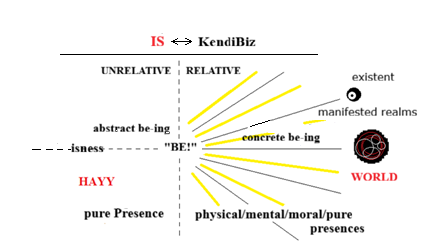
In the Thread of Be-ing (see Figure), Hayy is positioned as the life-granting Truth within the field of Is — the point where contextless be-ing and concrete being flourish in mutual inclusion, where isness becomes productive as the creation. The manifest world is not below Is or separate from Is. Creation is Is in its relative expression.
The precise formulation of Ibn Sina: Hayy is that which knows its own essence without any external influence — pure self-knowing, prior to all relation, yet already the source of all relation.
To be alive is already to be embraced by Hayy — whether one knows this or not. This is why the Unrelativity framework names life as Divine Identity — own-ing (as in belonging) OwnSelf.
To Manifest — Varlanmak
The verb varlanmak — coined specifically for the Unrelativity framework — means to come into existence: to take on the character of a concrete present (an existent thing), to manifest relatively within the dimensions of time and space. This is distinct from to be, in the pure sense without manifesting.
Pure Presence is the cause of existence; there is no such thing as pure manifesting — manifesting always implies location, relation, and limit.
The habit of confusing these two is the root of what the framework calls the confounded context syndrome: the mistake of applying the logic and language of relative existence to the unrelative ground of Be-ing (Pure Presence).
Be-ing — Olunum
The hyphen in be-ing is doing philosophical work. It distinguishes the act of be-ing — the dynamic, continuous process by which isness expresses suchness — from “being” as a static noun.
Be-ing has two modes:
Unbound be-ing — the unmanifest, incorporeal dimension, oriented toward the unrelative. The spiritual root of every existent: its belongingness to the divine ground, to Hayy.
Concrete be-ing — the manifest dimension: the physical, mental, and moral presences through which isness expresses suchness as and in the relative world.
The pivot between these two modes is the divine formative act: “BE!” — Kun! in Arabic, Ol! in Turkish. Not a past event but the eternal present tense — the continuous, undivided act by which the unrelative ontologically morphs into the relative without ceasing to be unrelative. This reality is formulated by the mutual inclusivity principle.*
Be-ing is not a bridge between two separate realms. Be-ing is mutually included by both:
Unbound be-ing ⊙ Concrete be-ing ↔ IS
* Formulation: shaping through elements, giving form.
Mutual Inclusivity — Müştereken İçlenme
Mutual Inclusivity is the ontological principle at the heart of the entire Unrelativity framework — not merely a logical relation but a name for the living reality by which the unrelative and the relative are integral without either being reduced to the other.
The relative and the unrelative are not opposites. They are not two separate realms stacked vertically, with the divine “above” and creation “below.” The Mutual Inclusivity principle refuses that image entirely. The relative is grounded in the unrelative — without the unrelative being reduced to the relative. The unrelative is present within the relative — without the relative being absorbed into the unrelative.
“I am in the Father and the Father is in me.” — John 14:11
“When you threw, you did not throw — but God threw.” — Qur’an 8:17
The act is simultaneously human and divine, relative and unrelative, without either canceling the other. Mutual Inclusivity is not an abstract principle. It is the living structure of every moment.
The Operator
The symbol ⊙ — a point held within a circle — denotes Mutual Inclusivity. The formal expression:
u ⊙ r ↔ Olu
The unrelative (u) and the relative (r), held in Mutual Inclusivity (⊙), is (↔) Olu — Is, OwnSelf. The ↔ here is ontological equivalence: the result does not merely point toward Olu — it actually is Olu.
“Is nature God?” — No, because r alone is not u ⊙ r. “Is God separate from the world?” — also No, because u alone is not u ⊙ r either. Mutual Inclusivity holds both negations and names what neither pole can name alone.
Two Metaphors
The Self-Painting Canvas — Kendini Boyayan Tuval
The canvas is simultaneously the painter, the paint, and the painted. There is no external painter applying form to an inert surface — the canvas paints itself, formulating own suchness. This is called Selfhood as the creative ground: not a substrate waiting for form from outside, but by acting on own self-presence to facilitate and allow for all colors to live with grace. Such living in diversity through Own be-ing forbids separation for all by virtue of belonging as Is.
The Carpet, its Thread, and its Knots — Halı, İplik, Düğüm
Thread is the linear, unmanifest (objective) formulating potential; the knot is the (subjective) manifest formulation. Neither thread alone nor knot alone is the carpet form. The carpet is their Mutual Inclusivity — the living whole that neither can constitute without the other. This is Presence: Unbound be-ing ⊙ a being — the woven Unity with a name Is.
KendiBiz — We the Self
KendiBiz is the central coinage of the Unrelativity framework — kept in Turkish even in English contexts because it most resists concise translation but needs explication.
Kendi means OwnSelf — “I am that I am.” Biz means We — not a collection of individuals gathered, but the unitary We of formulation — the Holistic Is — where nothing is absent. The Quranic “We are closer to him than his jugular vein” is this “We” — with perfect inclusion — self-presence-ing from within every being.
KendiBiz does not imply either pantheist (God is everything, difference abolished) or hard theist (God is wholly other, absolute difference) theosophy. KendiBiz acknowledges the holistic Real unified through Mutual Inclusivity of:
the Self that is first and always of Divine Is’ness, and
the We that is sacred because it is later the whole of creation — Oneness
Kendi ⊙ Biz ↔ KendiBiz ↔ Olu
Self ⊙ We ↔ We the Self ↔ Is
Selfhood — Kendilik
Selfhood is not a psychological concept. It does not name personality, individuality, or the egoic self in charge of ordinary experience. It names the ontological singularity of Is — the fact that Is embraces all there “is” as the one Self: unrepeatable, non-composite, undivided.
In the human as a being, selfhood names the conceptual “as such” dimension prior to all formulations by relative identities through attachment and bondings — prior to nationality, religion, gender, and history. As Mevlana expressed it: the human being is not merely a drop in the ocean — the human being is simultaneously the ocean in the drop. The drop’s selfhood is ontologically equivalent to the Ocean’s Selfhood.
“There is Self [Me] within me, deeper than myself [me].” — Yunus Emre
Selfhood is the Now. Selfhood is not the changing position in time. It is the living Now — the present instance of be-ing at which the unrelative and the temporal mutually touch without either being consumed by it, yet inseparable and undual.
Suchness of Selfhood — Kendiliği
The term “Kendiliği” names the ontological suchness of Selfhood — the sheer fact of being the holistic Self, as a living or otherwise actuality. Where Selfhood (Kendilik) names the Oneness as the divine singularity, suchness of Selfhood (Kendiliği) names the unrelative aspect of be-ing as a matter of fact of Selfhood as OwnSelf, the sole including “totality” by presence: the first-person facticity, non-transferable actuality of be-ing OwnSelf — the non-duality of what divinity speaks of.
This is the most intimate of all knowing — and the most easily overlooked. It cannot be negated, deferred, or transferred. If one tried to point even with a word, that pointer is without exception already within — hence will realize the pointer is self-pointing. One can also comment: the pointer is the pointed to.
Own-ed Belonging — Aidiyet
Belonging is being in the possession of the presences that define us — the orientations that, whether or not we are aware of them, underlie every choice we make and every relation we owningly inhabit.
Relative belonging is the real network of relations in which any person finds their place and meaning — an own-ed bouquet of colorful belongings that cannot be duplicated.
Unrelative belonging is our pure Presence — the source of vitality given through be-ing oneself. Isness, like the soil in which a sapling takes root, is made available to all as the source of be-ing a life.
Divine Belonging is the unrelativity of all belonging. Every manifest entity possesses an unconditional, non-transferable own-ed-ness by the whole of Is that sustains All. This context cannot be earned, lost, or transferred. It is the grace of Mutual Inclusivity of the unrelative, with zero separation — belonging without duality as the own-ed (deemed by Divinity as own mercy).
“We are closer to him than his jugular vein.” — Qur’an 50:16
“I and the Father are one.” — John 10:30
Instanding — An’lanma
Instanding is unrelatively spiritual experience through peak consciousness. It is transcending concrete being over the ontological threshold, by being allowed to get in touch with the all-consuming pure Presence in the moment.
Instanding is the direct, first-person liberating experience via Divine Belonging — the awareness, in the present moment, of one’s unrelativity, without intermediary. Counter to this is relative understanding which is mental re-cognition through the mind’s symbolic constitution, viscerally causing all relativity.
Where understanding reaches through senses — toward an object, a thought, a fact in the relative world — instanding is the ending of movement inward, toward the unrelative ground of the one who moves for self-knowledge. It is the moment in which the relative self recognizes own unrelative ground: not as a thought about Pure Presence, but as contextless self revealing Pure Presence.
The Turkish term an’lanma carries within it the element an (the Now) — making explicit that this is the instantaneous ontological acquisition of the timeless Presence by the “Now” moment, not a gradual process. The Sufis called it fenafillah; the Zen tradition speaks of satori; Eckhart wrote of the spark’s return to its ground. Instanding is the name for those same events in the lexicon of the Unrelativity framework.
Instanding cannot be forced or manufactured. It can be prepared for — through the self-knowing movement: through practice of objectivity, through the purification the Compass describes, through contextless self-observation. But it arrives as graceful gift, not achievement — the hidayat of every moment, already given and ready for the pure consciousness to touch.
Consciousness — Bilinç
Consciousness is the mental capacity that will provide immediate unity in the (k)now. For the final analysis it is the mind’s masterful act of forming and integrating perception of the surrounding current state of affairs — coined as “suchness.” Consciousness is meta-reality.
In the context of awareness this mastery will use justice as the operating principle. Harmony ensured by the mind’s ownership for wellbeing for own self and others, consciousness evolves with equivalency to its surroundings — forming and utilizing own gestalt. Here the Compass plays its key role while consciousness gathers truths from all avenues — always quietly asking: “how far away am I from completing the picture?” Mindfulness of egoic involvement in the makeup of personal consciousness is determined through self-reflection. Relatively speaking how easily one can — if at all instand Oneness — acquire the complete picture is the question in front of the project.
Consciousness is the gestalt of the moment: how the current gestalt submits to pure Presence is the target for the framework.
Zero consciousness is deadness. Full consciousness is instanding. The peak of unattached consciousness resides in unrelativity — in a state of unity in purity: consciousness will experience Selfhood in the oneness of the knower and the known while standing in pure Presence. The separation caused by mental (noumenal) duality is ended. In its absence, the individual is ontologically re-born through instanding — such peak consciousness morphs into unrelative wisdom.
A Note on Method
The Unrelativity framework is a way of seeing — a shift in the orientation from which reality is perceived and acquired.
The concept terms above are not definitions to be memorized but directions — each one pointing toward a way of attending that, if genuinely followed, opens into something the term itself cannot contain. Language here functions apophatically: it names what it cannot fully capture, and in doing so creates the conditions for a more unattached encounter with what is as “such” being pointed at.
The practical instrument for navigating this territory is the Compass — developed in Kavuşturan Pusula and described in the Themes section. The Compass maps the lived territory between the relative self and the unrelative ground and offers a concrete framework for the journey the Core Concepts describe.
Two Metaphors
The Self-Painting Canvas — Kendini Boyayan Tuval
The canvas is simultaneously the painter, the paint, and the painted. There is no external painter applying form to an inert surface — the canvas paints itself. This names Selfhood as creative ground: not a substrate waiting for form from outside, but the self-originating act of be-ing expressing itself without division.
The Carpet, its Threads, and its Knots — Halı, İp-lik, Düğüm
Thread is the linear, unmanifest potential; the knot is the fixed, manifest form. Neither thread alone nor knot alone is the carpet. The carpet is their Mutual Inclusivity — the living whole that neither ingredient can constitute apart from the other. This is also be-ing: Abstract be-ing ⊙ Concrete be-ing — the entangled whole whose name is isness.
 unrelativity.xyz